The alchemy of gold.
Back to scratch, the Big Bang created hydrogen, the lightest and most abundant element in our
periodic table. As stars shine, they fuse hydrogen into heavier elements like carbon and oxygen,
which are the core elements of life. In their dying years, stars create the more common metals –
aluminum and iron – and blast them out into space in different types of supernova explosions.
Scientists have long theorized that these stellar explosions also explained the origin of the
heaviest and most rare elements, but they were missing evidence. It hinges on the object left
behind by the death of a massive star: a neutron star. Neutron stars pack one–and–a–half times
the mass of the sun into a ball only 10 miles across. A teaspoon of material from their surface
would weigh 10 million tons. That’s pretty heavy.
Many stars in the universe are in binary systems – two stars bound by gravity and orbiting
around each other. A pair of massive stars might eventually end their lives as a pair of neutron
stars. The neutron stars orbit each other for hundreds of millions of years. But Einstein said that
their dance cannot last forever. Eventually, they must collide. Einstein knew best.
On the morning of August 17, 2017, a ripple in space passed through our planet. It was
detected by the LIGO and Virgo gravitational wave detectors. This cosmic disturbance came
from a pair of city–sized neutron stars colliding at one third the speed of light. The energy of this
collision surpassed any atom-smashing laboratory on Earth.
Astronomers immediately ran to the telescopes large and small and scanned the patch of sky
where the gravitational waves came from. Twelve hours later, three telescopes caught sight of a
brand new star – called a kilonova – in a galaxy called NGC 4993, about 130 million light years
from Earth.
Astronomers had captured the light from the cosmic fire of the colliding neutron stars. Just like
the embers of an intense campfire grow cold and dim, the afterglow of this cosmic fire quickly
faded away. Within days the visible light faded away, leaving behind a warm infrared glow, which
eventually disappeared as well.
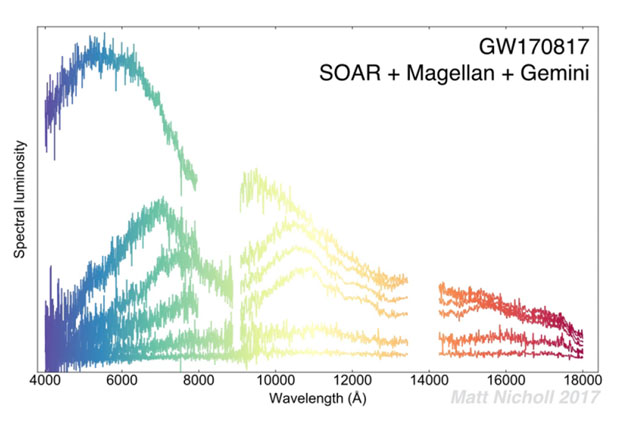
But in this fading light was encoded the answer to the age–old question of how gold is made.
Shine sunlight through a prism and you will see our sun’s spectrum – the colors of the rainbow
spread from short wavelength blue light to long wavelength red light. This spectrum contains the
fingerprints of the elements bound up and forged in the sun. Each element is marked by a
unique fingerprint of lines in the spectrum, reflecting the different atomic structure.
The spectrum of the kilonova contained the fingerprints of the heaviest elements in the universe.
Its light carried the telltale signature of the neutron-star material decaying into platinum, gold
and other so-called “r–process” elements.
For the first time, humans had seen alchemy in action, the universe turning matter into gold.
And not just a small amount: This one collision created at least 10 Earths’ worth of gold.
The metal you are wearing around your was created in the atomic fire of a neutron star collision
in our own galaxy billions of years ago ─ a collision just like the one seen on August 17.
And what of the gold produced in this collision? It will be blown out into the cosmos and mixed
with dust and gas from its host galaxy. Perhaps one day it will form part of a new planet whose
inhabitants will embark on a millennia–long quest to understand its origin.
Orginally written byDuncan Brown,
Professor of Physics, Syracuse University
and Edo Berger,
Professor of Astronomy,Harvard University.
And not just a small amount: This one collision created at least 10 Earths’ worth of gold.
The metal you are wearing around your was created in the atomic fire of a neutron star collision
in our own galaxy billions of years ago ─ a collision just like the one seen on August 17.
And what of the gold produced in this collision? It will be blown out into the cosmos and mixed
with dust and gas from its host galaxy. Perhaps one day it will form part of a new planet whose
inhabitants will embark on a millennia–long quest to understand its origin.
Orginally written by
Professor of Astronomy,